
Carbon-Ukraine - Equipment Manufacturing
Self Propagating High Temperature Syntheis Reactor – SHS Reactor, customized equipment manufacturing
Our Ukrainian partner Materials Research Centre (MRC) offers manufacturing of SHS Reactor.
Our partners from MRC (Kiev, Ukraine) design and manufacture customized laboratory reactors for Self-Propagating High-Temperature Synthesis
Self-Propagating High-Temperature Synthesis (SHS), also known as combustion or autoignition synthesis, creates materials by starting an exothermic reaction among powdered reactants. It stands out for being self-sustaining—generated heat continues the synthesis without needing an external heat source. SHS is widely used in making various materials like ceramics, intermetallic compounds, and composites.
The design of a reactor for Self-Propagating High-Temperature Synthesis (SHS) is a critical aspect of ensuring the success and safety of the process. The reactor must be able to initiate and sustain the exothermic reaction while allowing for control over key parameters.
We provide development of SHS technologies, design and manufacturing of customized specialized equipment intended for synthesis of novel materials using non-critical raw materials as a precursor for SHS technology.
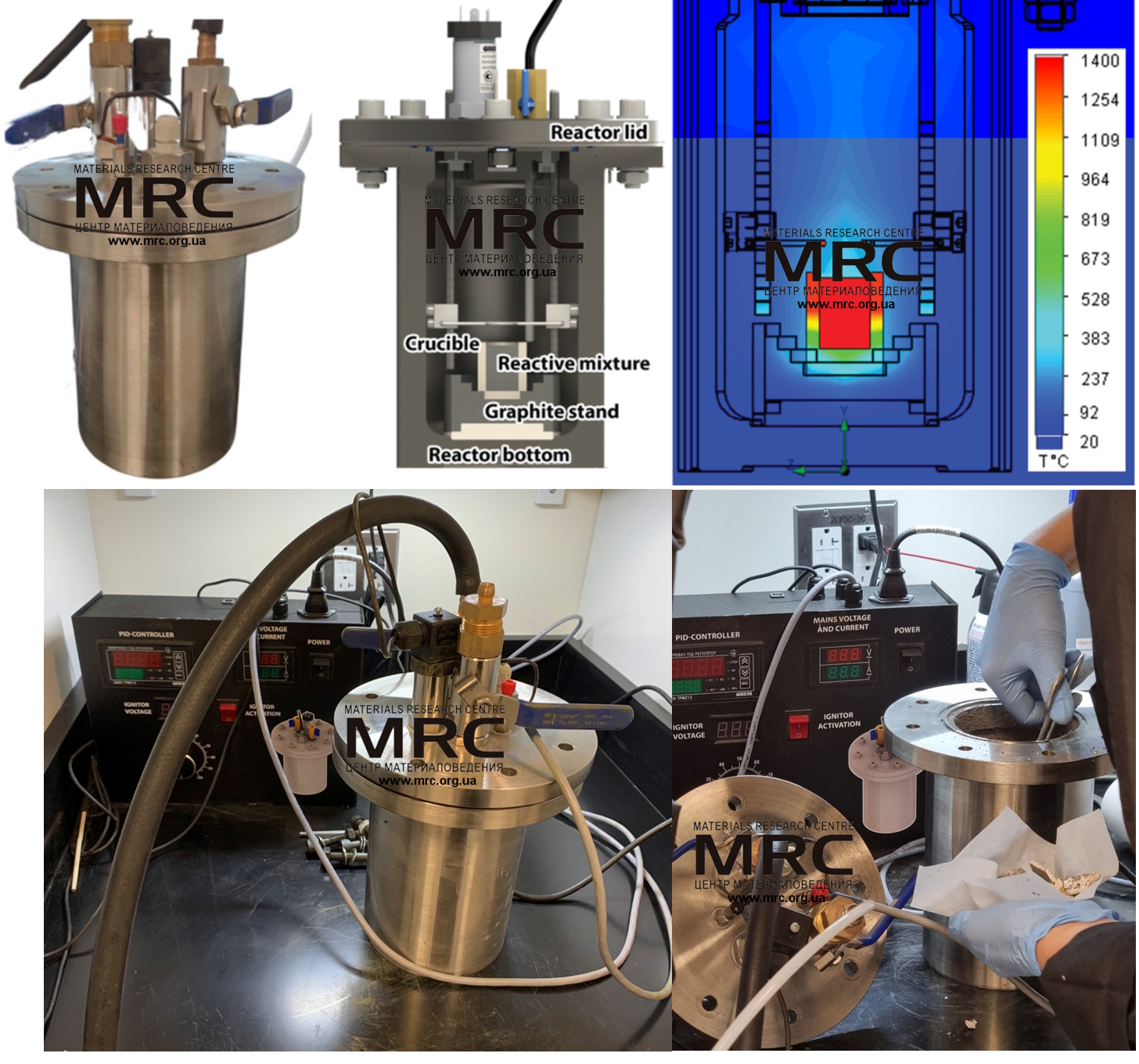
SHS reactor and its thermal model: General view of the SHS reactor; Cross-section of the reactor; Thermal model of the SHS reactor with 60 g of the reaction mixture showing the temperature field in the reactor during the combustion synthesis.
Vorotilo, S., Shuck, C.E., Anayee, M. et al. Affordable combustion synthesis of V2AlC precursor for V2CTx MXene. Graphene and 2D mater 8, 93–105 (2023). https://doi.org/10.1007/s41127-023-00059-1
For orders please contact us at sales@carbon.org.ua
Boron Carbide Products
Boron Carbide Products
We provide development and manufacturing various products and parts from boron carbide. Our boron carbide products have increased strength and abrasion resistance for high-pressure.
Nozzles made of boron carbide


Technology
Our specialty carbon production process…
The development of commercial processes for producing specialty carbons is currently attracting attention across a wide range of industries. Carbon-Ukraine’s high-performance specialty carbon nanomaterials represent one of the most promising directions in this emerging field. Our production process allows for nanoscale control over carbon porosity. Carbon-Ukraine has developed a scalable, cost-effective platform for manufacturing porous carbon nanomaterials for a wide range of applications. Our carbons includes carbide derived carbon, polymer derived carbon and high purity activated carbon obtained from natural sources.
The carbide-derived carbon process involves etching metal atoms from metal carbides, e.g. removing Si atoms from SiC by etching with halogens, to produce porous carbons templated by the precursor carbide. Varying specific process parameters allows us to systematically control the structure and porosity of the carbon produced, resulting in a “tunable” materials system with a wide range of possible materials. Faster, more precise, and more controllable than the conventional multi-step pyrolytic processes employed to produce conventional activated carbons, Carbon-Ukraine carbide-derived carbon technology requires only a single step to produce highly-pure porous carbon.
The polymer-derived carbon process involves a two-step process; pyrolysis followed by activation. Polymer-derived carbon is very clean, dust free, and contains very little ash (less than 0.2%). Selection of different polymer precursors results in control of pore sizes, surface chemistry and particle shape. Spherical hard carbon particles can be used in applications such as flow capacitors where fast absorption capability, excellent wear resistance, and minimum pressure drop are desired.
Our commodity based activated carbon production process...
Our commodity-based activated carbons are primarily manufactured from three raw materials: fruit pits, coal and wood. Pyrolysis or carbonization and activation are the two major steps for producing activated carbons. The pyrolysis process involves removal of moisture and volatile matters from the raw material. In pyrolysis, the raw material is exposed to an inert atmosphere at 600 to 900°C. Once pyrolysis is completed, the “char” is activated. Activation results in creation of micro- and meso- pores. In the activation process, the “char” is exposed to activating agents such as carbon dioxide, steam, or potassium hydroxide, at temperatures between 600 to 1000°C.
Customization…
We can provide materials with specific properties optimized for a given application. Our engineers are experienced in determining the material characteristics needed for a variety of applications, while our process flexibility allows us to readily tune a material to offer optimal performance.
Below are some of our custom manufacturing capability:
• Narrow, broad, or hierarchical pore size distribution, with mean pore sizes from 0.6 to >20 nm are available
• High specific surface areas up to 2,000 square meters per gram and pore volumes up to 1 cubic centimeter per gram available
• A wide variety of form factors are possible, including micron-sized powders, nanopowders, spherical powders, coatings, monoliths, and fibers
• Systematic control over surface chemistry for tailoring sorption behavior and hydrophobicity/hydrophilicity
• Metals, metal oxide, metal carbide, and halogen inclusions can be retained in the final material to improve performance for a specific application