

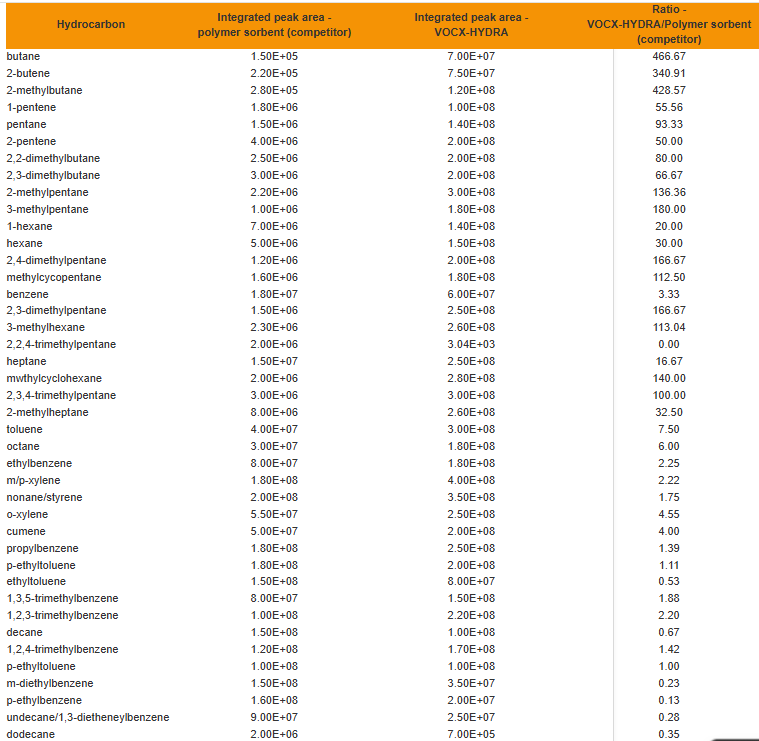
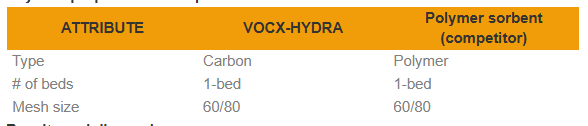
The ability to adsorb wide range of volatile organic compounds (VOCs) present in low concentrations is critical to sampling of hydrocarbons. The plot below compares the performance of our VOCX-HYDRA – a porous carbon adsorbent based single bed trap (referred as “VOCX-HYDRA” in the plot below) with a commonly used porous polymer adsorbent based single bed trap (referred as “Polymer sorbent (competitor)” in the plots below). The test was done by an independent laboratory specializing in hydrocarbon sampling. Porous polymer based adsorbent are used most commonly in sampling of gases consisting hydrocarbons. They have a wide volatility range, are hydrophobic, and are considered in gas sampling applications in areas of high humidity. However, polymer adsorbents can decompose, releasing toluene, benzene, benzaldehyde, acetaphenone, benzophenone, other aldehydes, and ketones, when it is heated for desorption, resulting in a number of artifacts being observed in supposed blank samples.
Results and discussions
VOCX-HYDRA outperforms polymer sorbent (competitor) across a broad range of hydrocarbons VOCs. VOCX-HYDRA adsorbs from C4-C10 hydrocarbons in a fairly uniform fashion, while polymer sorbent (competitor) performance drops off below C7.
Features
1. Detection of broad spectrum of hydrocarbons present in low concentration: VOCX-HYDRA can adsorb wide range of hydrocarbons as compared to polymeric sorbent of our competitor.
2. Ability to work in high moisture environment: Water is a ubiquitous atmospheric contaminant which adversely affects gas sampling; atmospheric moisture which binds to a sorbent used in gas sampling prevents the adsorption of the desired VOC’s. In contrast to other sorbents, VOCX-HYDRA is highly hydrophobic while maintaining the ability to bind to majority of hydrocarbons.
3. Highly pure sorbent: VOCX-HYDRA is a highly pure carbonaceous sorbent with a purity of over 99.9%. VOCX-HYDRA has negligible sulfur content unlike sorbents from our competitors.
4. Ability to work at higher temperature: VOCX-HYDRA can be heated to higher temperatures (up to 400oC), speeding up desorption. High desorption temperature allows release of compounds that are strongly attached to the sorbent.
5. Easy packing of tubes: VOCX-HYDRA has high particle endurance (low friability). This makes the filling of tube “less messy” ensuring a long service life in applications where it is subjected to mechanical wear.
Other applications
Our sorbents can be used for a variety of thermal desorption (TD) related applications. TD is a widely used technique for extracting and isolating VOCs from various sources. It is often used for air monitoring (indoor, outdoor, workplace, automobile interior, breath, etc.) and is a valuable tool for the analysis of polymers, packaging materials, foods, flavors, cosmetics, tobacco, building materials, pharmaceuticals, and consumer products. Indeed, almost any sample containing VOCs can be analyzed using some variation of the TD technique. The TD market is divided into following applications:
(I) Process Control: Process control involves the monitoring of manufacturing processes to ensure quality control and consistency in manufacturing operations. For example, chemical detection can be used by pharmaceutical, food processing and petrochemical companies to monitor manufacturing processes and react when inconsistencies are identified.
(II) Health and Safety: Health and safety detection systems are intended to protect personnel occupying industrial facilities from hazardous chemicals. There is a known deficiency with existing sensors in industrial environments with respect to the simultaneous detection of multiple gases and the detection and concurrent identification of specific substances.
(III) Emissions Monitor – monitor the emission of harmful industrial gases into the atmosphere that may damage the environment; detection of toxic industrial compounds – test for the release of toxic compounds, monitor decontamination efforts and confirm effective remediation of the chemical agent.
(IV) Diagnostic Instrument – analysis of breath or bodily fluids for non-invasive diagnosis or monitoring of disease; treatment monitor – analysis of breath for non-invasive monitoring of treatment efficacy and progress; and anesthesia and respiratory monitor – detect exhaled anesthesia agents and other relevant indicators in the breath to minimize the response time of clinicians to vital signs.
(V) Homeland Security – The chemical detection market for homeland security has not slowed down despite a lull in terrorist activity. Chemical sensing, while showing the greatest potential and garnering much of the attention in homeland defense, has primarily been the domain of the military and first responders, leaving the general public and most government facilities unprotected. Rising concerns about chemical and biological terrorist attacks on military and civil targets have prompted the U.S. Government to authorize massive spending on test and evaluation (T&E), services, and procurement of chemical detection equipment. The Federal Government is the single largest spender on threat detection equipment, with departments such as the Department of Defense (DOD) and the Department of Homeland Security (DHS) installing detection systems in sensitive areas.
There are no articles in this category. If subcategories display on this page, they may contain articles.